

When family law disputes escalate, concerns about safety, communication, and children’s wellbeing often arise quickly. Many people assume that restraining orders can only be made in the Magistrates Court but that is not always the case. In certain circumstances, a Judge of the Family Court can issue injunctions and restraining orders against a party to proceedings.
However, there are important limits, particularly where state-based domestic violence orders already exist. Understanding how these systems interact is critical to ensuring you seek the right protection in the right court.
 Under section 68B of the Family Law Act 1975 (Cth), the Family Court has the power to make injunctions or restraining orders to protect children and parties to family law proceedings.
These orders can restrain a party from a wide range of behaviours, including:
These injunctions are often sought urgently and can play an important role in managing risk, reducing conflict, and stabilising parenting arrangements while proceedings are ongoing.
While the Family Court has broad powers, it cannot make injunctions that conflict with or duplicate existing state-based family violence orders.
Section 114AB(2) of the Family Law Act prevents a Judge from making an injunction if it would overlap with an operable domestic violence order made under state or territory legislation.
In Queensland, final family violence orders are made under prescribed state legislation and are recognised for the purposes of this section. This means that if a valid domestic violence order is already in place, the Family Court must avoid making inconsistent or competing orders.
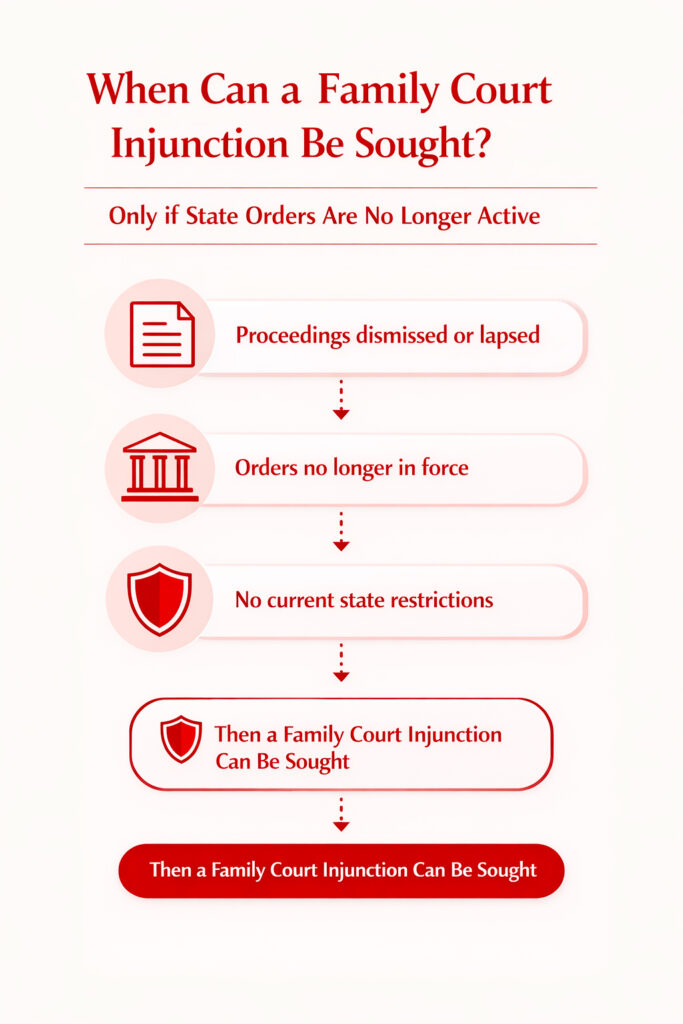 A person who has already commenced proceedings or taken action under state domestic violence legislation is generally not entitled to seek overlapping injunctions in the Family Court unless:
These provisions exist to prevent confusion, duplication, and enforcement issues between courts.
Choosing the wrong court or seeking overlapping orders can delay protection, increase legal costs, and create unnecessary stress particularly where children are involved.
The interaction between Family Court injunctions and domestic violence orders is complex, and the right approach depends on:
Getting clear advice early can make a significant difference to both safety and outcomes.
At James Noble Law, we assist clients across Queensland with urgent family law matters, including applications for injunctions, parenting orders, and advice where domestic violence orders are already in place.
Our team can help you:
We take a practical, client-focused approach helping you move forward with clarity, confidence, and protection where it matters most.
While the Family Court does have the power to issue injunctions and restraining orders, those powers are carefully balanced against existing state-based domestic violence laws. Knowing how and when these orders can be made is essential to protecting your rights and your family.
If you are unsure which court to apply to, or if you need urgent advice about safety, parenting, or communication restrictions, seeking early legal advice is critical.
Contact James Noble Law on 07 2112 3947 to arrange confidential advice and find out how we can support you through your family law matter with clarity, care, and practical solutions. Alternatively, book directly on our website at www.jamesnoblelaw.com.au
Find trusted Brisbane family lawyers on Google Maps or get in touch with us directly.